




Description
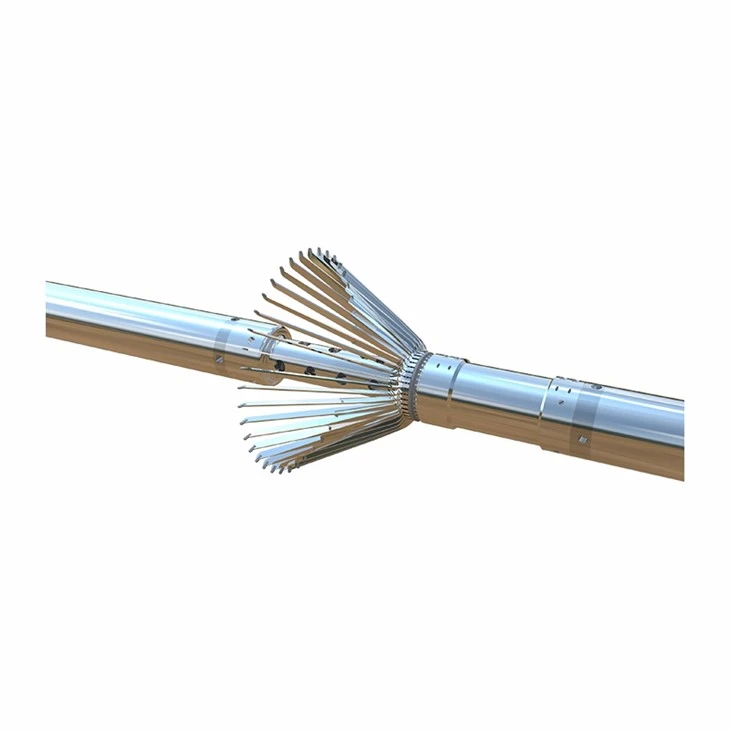
The Multi-Arm Caliper Tools are advanced downhole logging instruments engineered to provide high-resolution measurement of internal casing and tubing diameters, enabling accurate detection and quantification of structural anomalies such as corrosion, deformation, scaling, wear, and mechanical damage. Designed for wireline and memory logging operations, these tools play a critical role in well integrity evaluation, casing inspection, remedial planning, and long-term surveillance throughout the life cycle of oil and gas wells.
With configurable multi-arm arrays and robust mechanical and electrical design, Multi-Arm Caliper Tools deliver precise radial measurements that form the foundation of 2D and 3D tubular profiles-empowering engineers with actionable data that supports safer, more efficient well interventions.
What Is a Multi-Arm Caliper Tool?
A caliper log is a well logging measurement that records the internal borehole or tubular diameter as a function of depth. Traditional caliper tools use two or four arms to gauge diameter changes at specific orientations, which can lead to incomplete representations in non-circular or irregular boreholes. To overcome this limitation, Multi-Arm Caliper Tools deploy arrays of many independent measurement fingers (arms) distributed radially around the tool's body to capture a much finer and more complete cross-sectional profile of the inner borehole or casing geometry.
Each arm independently contacts the tubular wall and translates radial displacement into an electrical signal. When these signals are combined and processed, they produce a continuous diameter-vs-depth log and can be visualized in 2D or 3D formats, enabling precise identification of anomalies across the circumference of the pipe.


Technical Parameters
|
General Specs |
|
|
Pressure Rating |
100Mpa |
|
Temperature Rating |
175℃ (350°F) |
|
Working Voltage |
18-24V |
|
Working Current |
100mA |
|
Length |
1848.5mm |
|
Connection Length |
1798.5mm |
|
Logging Speed |
10m/min |
|
Connector Type |
13-Core |
|
Logging Conditions |
|
|
Is it possible to have H2S here |
Measurable |
|
Tool Position |
Center of Casing |
|
Dimensional Parameters |
|
|
Can be with an Extended Arm |
Can |
|
Diameter |
43mm (24-Arm) |
|
73mm (40-Arm) |
|
|
100mm (60-Arm) |
|
|
Well Diameter Measurement Range |
50mm~170mm (24-Arm) |
|
80mm~245mm (40-Arm) |
|
|
110mm~270mm (60-Arm) |
|
|
Measurement Accuracy |
|
|
Accuracy |
±1mm |
|
Resolution Ratio |
0.1mm |
|
Relative Azimuthal Accuracy |
±3° |
|
Relative Azimuthal Range |
0~360° |
|
Well Deviation Accuracy |
±3° |
Key Measurement Principles
1. Radial Multi-Arm Deployment
Unlike basic two- or four-arm calipers, multi-arm designs typically feature 24, 40, or 60 independent arms, each equipped with high-precision displacement sensors. These arms extend radially under controlled spring or mechanical force to maintain contact with the pipe's internal surface, capturing real changes in diameter at multiple azimuthal positions.
The distributed arm configuration ensures symmetry in measurement coverage, which greatly reduces the risk of mis-representation due to borehole ovality or irregular shapes - a known challenge in multi-arm logging.
2. Continuous Logging with Depth Correlation
As the tool is raised at a controlled logging speed, each arm records diameter measurements at consistent depth intervals. Combined with Casing Collar Locator (CCL) or depth indexing, this results in a highly accurate caliper log that maps the tubular profile from the logging depth range. Data can be recorded in real time or stored in memory for post-run download.
3. Data Visualization and Interpretation
Raw arm displacement measurements are processed and calibrated to provide meaningful diameter values. Advanced interpretation software can present the results as:
◆ Standard caliper logs (diameter vs. depth)
◆ Cross-sectional profiles
◆ 3D tubular geometry maps
◆ Color-enhanced visualizations
These visualization formats let engineers quickly locate structural defects and quantify changes in internal geometry, facilitating informed decisions.
Technical Features & Capabilities
High-Resolution With Multi-Arm Coverage
◆ 24, 40, or 60 independent arms capture radial measurements around the full circumference.
◆ Improves accuracy over conventional 2-arm tools, particularly in irregular or non-circular boreholes.
Robust Downhole Design
◆ Designed for harsh downhole conditions with high temperature and pressure ratings (often up to 175 ºC and 100 MPa).
◆ Hardened arms and mechanical components ensure durability and repeatability.
Memory Logging Modes
◆ Support for downhole memory logging enables flexible deployment depending on operational needs and rig capabilities.
Auxiliary Sensors
◆ Many tools integrate additional sensors such as inclination and azimuth to enable correction for tool orientation and well deviation, enhancing the interpretability of radial measurements.
Modularity and Integration
◆ Built to integrate with standard logging systems and panels for seamless data acquisition and processing workflows.
◆ Can be combined with other logging technologies (e.g., centralizers, corrosion meters) in a single trip to acquire multiple datasets efficiently.
Applications in Oil & Gas Operations

Multi-Arm Caliper Tools support a wide range of downhole evaluation and integrity applications:
Casing & tubing corrosion assessment: Detect and quantify internal metal loss due to corrosion or erosion - a critical indicator for monitoring well integrity and safety.
Deformation & buckling identification: Reveal changes in internal diameter caused by mechanical stress, bending, or collapse.
Scale and deposit profiling: Evaluate the presence of scale, paraffin, or other solids that can restrict flow and affect production performance.
Completion component inspection: Assess the internal profile of completion hardware (packers, liners, screens) for wear and fit conformity.
Time-lapse surveillance: Repeat logging over time enables trend analysis for corrosion progression or deformation evolution, supporting predictive maintenance and reliability planning.
Why Engineers Trust Multi-Arm Caliper Measurements
Caliper logging is a fundamental technique in well logging that directly measures casing and borehole geometry rather than inferring it from secondary signals. Traditional caliper principles rely on mechanical arm displacement to determine diameter changes - a methodology that has been industry standard for decades due to its simplicity, directness, and reliability.
Multi-Arm Caliper Tools extend this principle by increasing the number of measurement points around the circumference, significantly improving spatial coverage, reducing uncertainty caused by borehole ellipticity, and enabling true geometric representation of internal tubular surfaces.
The Multi-Arm Caliper Tools provide industry-proven, high-resolution insights into downhole tubular geometry, enabling operators and service companies to diagnose structural issues with confidence and plan interventions that minimize risk and maximize efficiency. Whether you are conducting a routine integrity check, planning a remedial job, or performing long-term surveillance, Multi-Arm Caliper Tools deliver robust, data-driven foundations for well integrity decisions.
Hot Tags: multi-arm caliper tools, China multi-arm caliper tools manufacturers, suppliers, factory


